A nurse at Brigham and Women’s Hospital, Sarah Thompson, MSN, RN, CCNS, CWON, has been on the front lines of the opioid crisis, educating patients and providers about the safe use, disposal, and storage of opioid medications.
Earlier in her career, Thompson, a professional development manager, worked as a clinical nurse educator within the colorectal surgical oncology unit at Brigham and Women’s Hospital (BWH). After some patients underwent surgery, they were discharged with a temporary fecal diversion and an opioid prescription. Weeks or months later, Thompson and staff nurse Margaret Costello, PhD, RN, met these patients again as they returned to have a second surgery, ostomy removal.
“We noticed that many patients were still taking their opioid medication when they returned for their reversal procedure six to 12 weeks later,” said Thompson. “Why hadn’t they stopped taking their opioid prescription? How prevalent of a problem was this? How many pills were they being discharged with? Did the nurses on the unit provide patients with enough education about safely going home with an opioid prescription?”
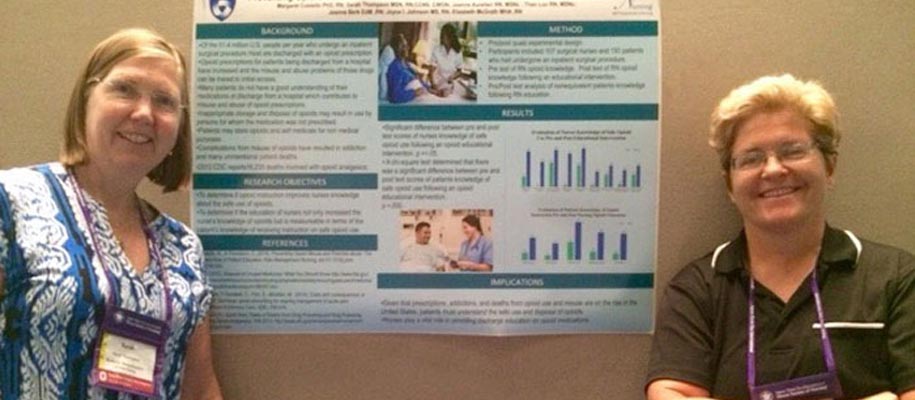
In 2014, this led Thompson and Costello to investigate how opioid education influenced a patient’s use of their medication.
The first research study evaluated how much nurses knew about opioids. Thompson and Costello discovered that nurses needed more information and resources to adequately educate their patients about the proper use, storage and disposal of opioid medication.
From that research and with input from Costello, Thompson created the Opioid (Narcotic) Medicine Information Sheet, a guide that nurses could use to educate patients about the safe use of opioids. The information sheet explains how opioid medications function in the body, how they should be taken, the potential risks and side effects, and how opioids should be stored and disposed. Nurses use the tool, given to the patient upon discharge, to teach them about opioids.
In 2016, Thompson and Costello conducted another nursing study that compared patients who received formal opioid education from nurses with patients who had not been educated. The results showed that educated patients felt more knowledgeable about the safe use of their medication. The study confirmed that nurses could help prevent opioid abuse and misuse if they devoted time to educating their patients.
Thompson and Costello led a hospital-wide campaign to teach providers about the safe use of opioid medications. They gave lectures, attended Unit Nurse Practice Councils, and spoke to physicians and nurses during Grand Rounds. Her information sheet was vetted with numerous groups at BWH, including the patient education committee and the nurses executive board.
Thompson was recently welcomed as a member of the institution-wide response to the opioid addiction crisis, known as the Brigham Comprehensive Opioid Response and Education (B-CORE) Program, that has developed hospital-wide best practices for opioid addiction prevention and management, opioid prescribing and chronic pain management. The B-CORE group incorporated Thompson’s information sheet into the electronic patient discharge instructions.
In 2018, Thompson assumed her current role as a professional development manager, where she hopes to continue to fight the opioid crisis by making systemic changes to hospital policies, programs and procedures.
“I’m passionate about helping patients on an individual and global level. At the bedside, I listen to their fears and biggest worries and help patients by providing hope and information. Now I also want to make an impact on a larger scale by influencing programmatic changes that affect the quality of care for all patients,” said Thompson.