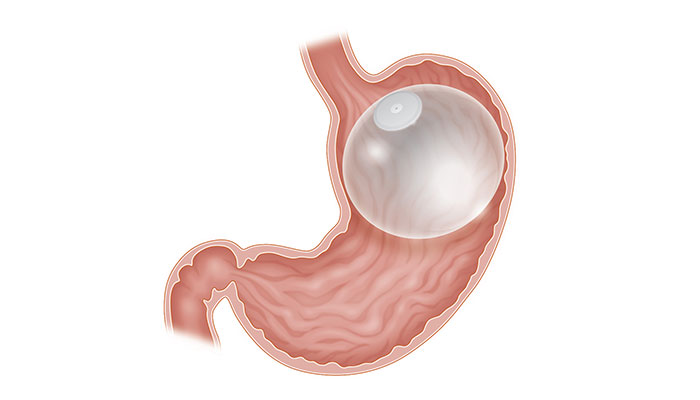
An endoscopic weight loss procedure is a non-surgical approach that uses an endoscope for your weight loss treatment, instead of external incisions (cuts). An endoscope is a thin, flexible tube that helps a doctor view your digestive system. Endoscopic procedures are considered very safe and less risky than surgery.
Intragastric balloons, one of the many procedures offered by our team, can be appropriate for certain patients based on factors like BMI and medical history. Our team can work with you to decide if this is the right weight loss procedure for you.
The intragastric balloon is a silicone balloon that’s about the size of a grapefruit or a softball. When placed in your stomach, the balloon limits the amount of food you can eat and makes you feel full faster. Over time, this helps you to lose weight.
While you’re sedated, the balloon is placed into stomach using an endoscope. This process usually only takes about 15 minutes. Once the balloon is placed in the stomach, it’s filled with saline. After treatment with the balloon, patients wake up and go home that same day. After 6 months, the balloon is removed.
Patients who have the intragastric balloon weight loss procedure typically lose 10 to 15 percent of their total body weight.
The recovery period is generally only a couple of hours in the endoscopy recovery room. You may receive some IV fluids (fluids given through a vein) and antiemetics (anti-nausea medicines). Patients are usually discharged from the hospital the same day as treatment.
You will be on some dietary restrictions following the procedure. You first follow a full liquid meal plan, which includes protein shakes and similar products. You then transition to a soft food plan (including easy-to-eat foods, like oatmeal, bananas and soft-cooked rice). Finally, you can return to regular eating within two weeks of the procedure.
You might experience better health, like improvements in weight-related health conditions. These can include sleep apnea, high blood pressure, type 2 diabetes, fatty liver and dyslipidemia. Dyslipidemia is when you have abnormal amounts of lipids (fats) in your blood. In some cases, these conditions may even resolve completely.
To qualify for intragastric balloons, you need a body mass index (BMI) of between 32 and 40. Healthcare professionals use BMI to determine your health risk for weight-related diseases. It’s based on a formula that considers your current weight and height. While it’s not a perfect method, BMI can be a useful health indicator for many people. To find out your BMI, you can use our BMI calculator.
Balloons are not appropriate for all patients. Your doctor will determine if you are a candidate for this method based on an evaluation of your health and medical history.
We like to see patients a few weeks before the treatment in order to describe the procedure in detail and answer any questions you may have. We also may start patients on a medication called a proton pump inhibitor. This medicine lowers the amount of acid in the stomach and helps prepare the stomach for the balloon. We also connect patients to dietitians so they can learn about the recovery meal plan after treatment.
In this video, Debbie, a patient at the Brigham’s Center for Weight Management and Wellness, shares how an endoscopic weight-loss procedure helped her lose 70 pounds. She achieved her weight-loss goals and improved her health and quality of life. Christopher C. Thompson, MD, describes the advantages of endoscopic therapies and the center’s patient-centered approach.
Yes. After the balloon is removed, the next step is an additional 6 months of medically supervised weight loss. During this time, your doctor and dietitian help guide your meal planning and check in with you regularly to help you achieve your weight loss goals.
We also provide support after the operation. We take a collaborative approach to treatment that combines the expertise of many different specialists. Our team-based approach, where doctors, dietitians, psychologists, and other medical specialists work together, helps us offer a very high quality of care.
Christopher Thompson, MD, MSc, AGAF, FASGE, FACG
Co-director of Center for Weight Management and Wellness
Director of Endoscopy
Director of Bariatric Endoscopy
Pichamol Jirapinyo, MD, MPH, ABOM
Associate Director of Bariatric Endoscopy
Director of Bariatric Endoscopy Fellowship
If you would like more information or would like to schedule an appointment with a Brigham doctor, you can call us at 617-525-3597 or fill out our appointment request form.
Physicians who are looking to refer a patient can call 617-525-3597 or email us at brighamweightloss@bwh.harvard.edu.
For over a century, a leader in patient care, medical education and research, with expertise in virtually every specialty of medicine and surgery.
About BWH